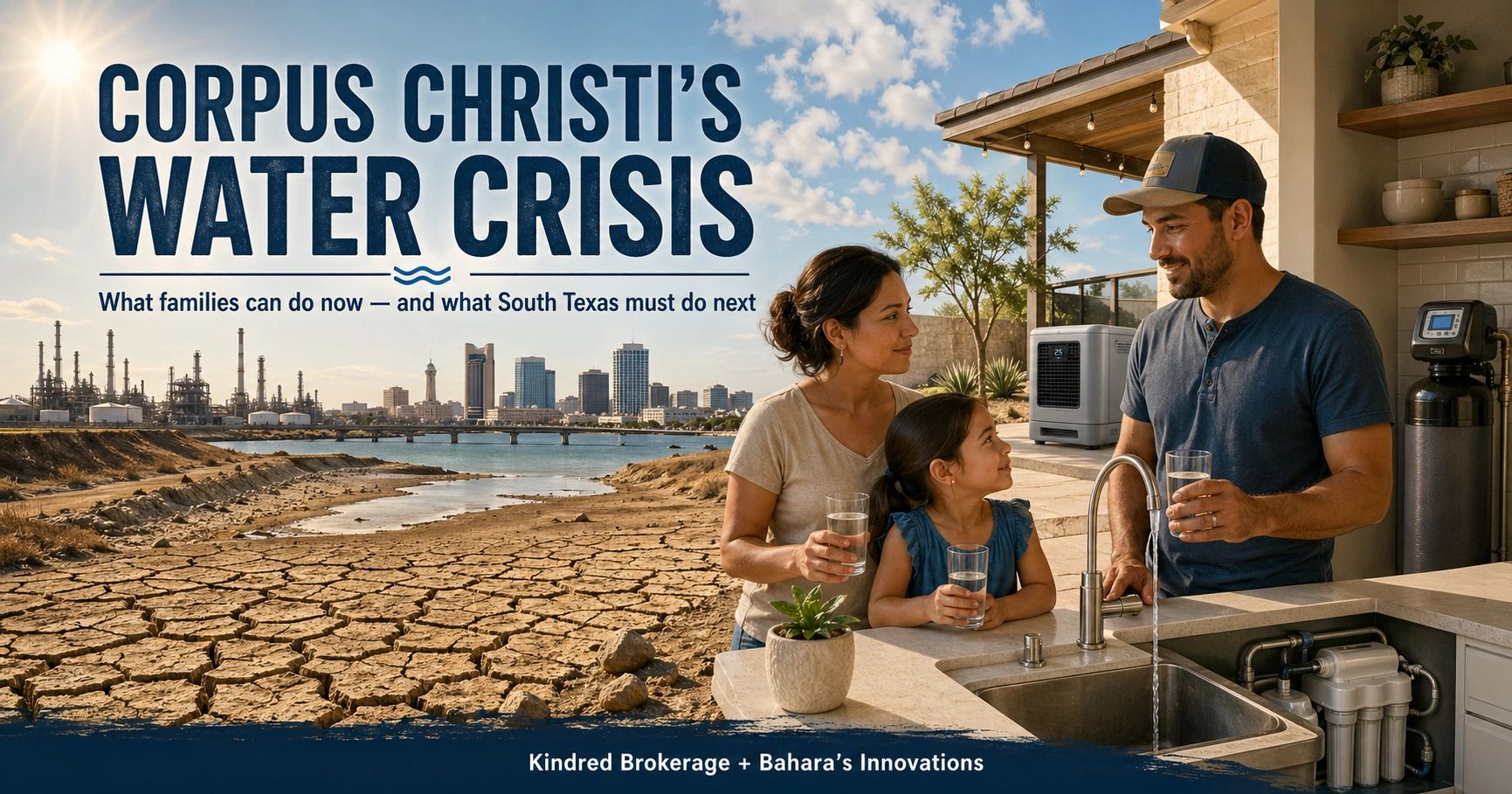
Corpus Christi’s Water Crisis Is Bigger Than Lawn Restrictions
A hotter summer is coming — and South Texas families need a real plan for water, health, and home protection.
A hotter summer is coming, and Corpus Christi’s water problem is no longer something we can shrug off as “just another dry year.”
This is not only about brown grass, car washes, or whether somebody can water their yard. This is about families, restaurants, hospitals, small businesses, surrounding towns, and major industrial users all pulling from a strained water supply.
Corpus Christi is currently under Stage 3 water restrictions, and the City’s water supply dashboard explains that a Level 1 Water Emergency is triggered when the City reaches the point where it is 180 days from total water supply not being enough to meet total water demand.
That does not mean the taps are empty today. But it does mean the warning lights are flashing.
And hoping for rain is not a water plan.
This Is a Water Supply Problem, Not Just a Homeowner Problem
Most regular families are already hearing the same advice:
Take shorter showers.
Stop watering lawns.
Fix leaks.
Run full loads of laundry.
Do not waste water outside.
That advice matters. Every household should be doing its part.
But we also need to be honest about the bigger picture.
Local reporting has stated that industrial users account for roughly 50% to 60% of Corpus Christi’s water use, including refineries, petrochemical operations, LNG-related facilities, and other large industrial consumers.
That does not mean every industrial company is the villain. Those businesses provide jobs, tax base, fuel, products, and economic activity. A lot of South Texas families depend on that work.
But here is the plain truth:
If families are being asked to sacrifice, the largest water users need to be part of the solution too.
Residents should not be the only ones carrying the guilt while the biggest users get treated like the water math does not apply to them.
A Hotter Summer Makes Everything Harder
South Texas heat is not gentle. When summer hits hard, water demand usually rises. People drink more, systems work harder, landscaping gets stressed, equipment breaks, and drought pressure becomes more obvious.
Local reporting has warned that Corpus Christi could face emergency restrictions by fall 2026 if the drought continues and supply projects do not close the gap fast enough.
That matters because water shortages do not just affect people at home. They ripple through the whole local economy.
Water affects:
- Food service
- Medical care
- Manufacturing
- Construction
- Home maintenance
- Tourism
- Insurance risk
- Public health
Water touches everything.
What About Weather Modification and Cloud Seeding?
A lot of people ask about weather modification. That is fair.
Weather modification and cloud seeding are real concepts. They are not just internet rumors. But they are also not magic.
Cloud seeding generally works by trying to enhance precipitation from existing clouds. It does not create storms from nothing. It does not refill reservoirs on command. And during drought conditions, the opportunities to use it effectively can be limited because the right cloud conditions may not be there.
The better way to say it is this:
Weather modification may be a tool, but it is not a rescue plan.
Corpus Christi cannot cloud-seed its way out of a long-term water supply problem. We need infrastructure, conservation, reuse, industrial accountability, and better planning.
Atmospheric Water Generators: Pulling Water From Air
One technology more people should understand is the atmospheric water generator, also called an AWG.
An atmospheric water generator pulls moisture from the air and turns it into water. The most common systems work somewhat like a dehumidifier: air is pulled across a cold surface, moisture condenses, and the collected water is filtered and treated.
The EPA describes atmospheric water generation as a technology that can produce potable water from surrounding air and may help expand water availability during shortages, contamination events, and other drinking-water interruptions.
That does not mean every home should run out and buy one tomorrow.
These systems depend on humidity, temperature, energy use, output capacity, maintenance, filtration, and cost. In a humid area like the Coastal Bend, the concept makes more sense than it would in a dry desert climate, but every situation still needs to be looked at carefully.
For some people, an atmospheric water generator may eventually make sense as part of a backup water plan. For others, basic filtration, reverse osmosis, leak repair, and water storage may be the better first step.
The point is this:
Families should start learning about options now, not after an emergency is already declared.
What Families Can Do Right Now
Here are practical steps every household can take.
1. Fix leaks immediately
A slow leak, running toilet, dripping hose bib, or broken irrigation valve can waste a shocking amount of water over time.
Do not ignore small leaks.
2. Stop treating grass like it is more important than drinking water
A green lawn is nice.
Reliable water is better.
South Texas families may need to rethink landscaping, outdoor watering, and what is actually worth protecting.
3. Install water-saving fixtures
Low-flow showerheads, faucet aerators, efficient toilets, and smarter appliance use can reduce waste without making life miserable.
4. Use full loads only
Run dishwashers and washing machines only when they are full.
That is basic, but it matters.
5. Store emergency water
Every family should have emergency drinking water stored.
Not panic. Preparation.
A water crisis is a lot less scary when you are not starting from zero.
6. Pay attention to water quality
During drought conditions, people often notice changes in taste, smell, sediment, hardness, and overall water quality.
That does not automatically mean your water is unsafe, but it does mean you should pay attention.
If your water smells strange, tastes off, stains fixtures, leaves heavy buildup, or has visible sediment, it is worth testing and asking questions.
7. Consider home water protection
This can include:
- Sediment filtration
- Carbon filtration
- Whole-home filtration
- Water softening
- Reverse osmosis drinking water systems
- Emergency storage
- Atmospheric water generation
- Better maintenance of wells and plumbing systems
Not every home needs the same setup.
A city-water home is different from a private well.
A family with health concerns is different from a rental property.
A small household is different from a business.
A backup system is different from a daily-use drinking water system.
That is why the answer should be matched to the property, not guessed.
Where Bahara’s Innovations Fits In
At Bahara’s Innovations, we look at water from a practical home-protection standpoint.
We help people understand options like water softeners, whole-home filtration, sediment filters, reverse osmosis systems, and newer technologies like atmospheric water generators.
That does not mean every person needs every product.
The goal is simple:
Help South Texas families understand what they are drinking, what their home is dealing with, and what options actually make sense before the problem gets worse.
If someone just needs information, that is fine.
If someone wants a water test, that is fine.
If someone wants to understand reverse osmosis, whole-home filtration, or water-from-air technology, we can talk through it without pressure.
Where Kindred Brokerage Fits In
Water is also a health conversation.
Clean water affects hydration, cooking, bathing, skin, kidneys, sanitation, and the health of children, older adults, and people with existing medical conditions.
At Kindred Brokerage, we help families look at the protection side of life: health coverage, Medicare, life insurance, cancer coverage, hospital protection, dental, vision, and supplemental plans.
Water, health, and finances are connected.
A crisis does not only hit your faucet. It can hit your body, your wallet, and your family’s stability.
That is why families need to think ahead.
Corpus Christi Needs a Real Water Plan
Corpus Christi needs more than slogans.
We need conservation.
We need leak repair.
We need smarter planning.
We need responsible industrial water use.
We need realistic infrastructure.
We need water reuse where it makes sense.
We need serious conversations about desalination, groundwater, storage, and backup supply.
We need residents and large users both doing their part.
And we need to stop pretending this is only about homeowners watering grass.
This is bigger than that.
The Bottom Line
Corpus Christi’s water crisis is already here.
A hotter summer will make it harder.
Families should not panic, but they should prepare.
Fix leaks.
Use less.
Store water.
Pay attention to water quality.
Understand filtration options.
Learn about backup water technology.
Ask better questions.
Hold leadership and large water users accountable.
Because in South Texas, water is not just water.
It is health.
It is business.
It is family.
It is survival.
And it is time we treated it that way.
Call to Action
If you live in Corpus Christi, Calallen, Robstown, Portland, Annaville, Orange Grove, Kingsville, Alice, or anywhere in the Coastal Bend and want to understand your home water options, call me.
Bahara’s Innovations
Water softeners, water filtration, reverse osmosis, water testing, and water backup options
361-726-0579
baharas.com
For health, Medicare, life, cancer, hospital, dental, vision, or supplemental coverage questions:
Kindred Brokerage
361-673-3512
kindredbrokerage.com
Sources
- City of Corpus Christi — Stage 3 Water Restrictions and Water Supply Dashboard
- Texas Tribune — Corpus Christi water shortage and industrial water use reporting
- EPA — Atmospheric Water Generation Technology Technical Brief
- Houston Chronicle — Corpus Christi emergency water restriction reporting